


Printify
Black Cowboys - Rufus Buck Gang
Black Cowboys - Rufus Buck Gang
Couldn't load pickup availability
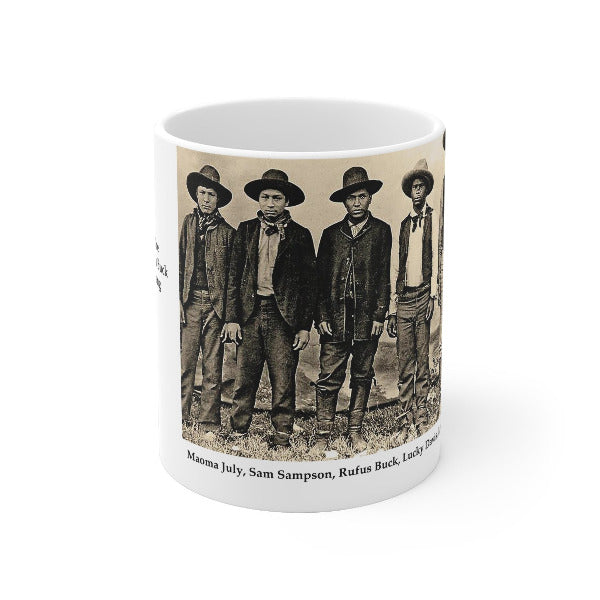
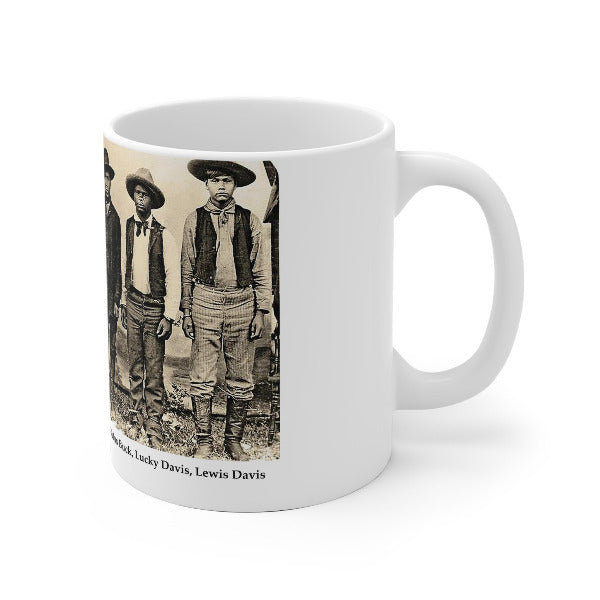
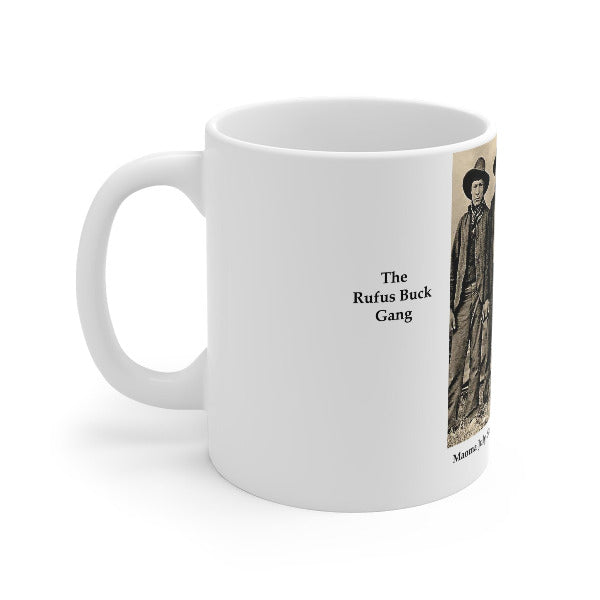
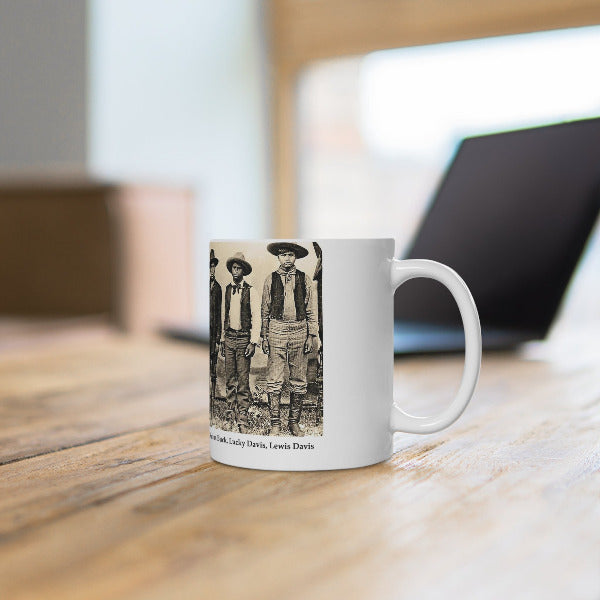
- Authentic 1896 Historical Photograph — Real image taken before their execution
- Netflix's The Harder They Fall — Inspired Idris Elba's character and the film
- Premium Ceramic Construction — Durable white ceramic with high-quality sublimation printing
- Two Convenient Sizes — 11 oz. or 15 oz. for your perfect cup
- Classic C-Handle Design — Comfortable grip with rounded corners
The Context: A Stolen Territory
To understand the Rufus Buck Gang, you must first understand what Indian Territory was in 1895. This wasn't "empty land" waiting to be settled. It was the forced destination of the Trail of Tears — where Creek, Cherokee, Chickasaw, Choctaw, and Seminole nations were brutally marched over 1,000 miles from their homelands in the Southeast, with thousands dying along the way.
These nations were promised this land in perpetuity — forever. But by the 1890s, the U.S. government was violating those promises, allowing over 50,000 white settlers to pour into Indian Territory illegally. The land that Indigenous people were told would finally be theirs was being stolen again. The railroad companies brought thousands more whites as traders and workers. Indian Territory was being colonized for the second time.
Into this powder keg of broken promises, stolen land, and seething resentment came Rufus Buck — an 18-year-old Yuchi man (allied with the Creek) whose mother was Black and whose father was Creek Indian. He had been expelled from Wealaka Mission boarding school for "unruly behavior." He'd served time for whiskey peddling. And he was burning with rage at what white settlers were doing to his people's land.
The Thirteen Days: July 30 - August 10, 1895
Rufus Buck assembled four other young men — all teenagers or barely in their twenties, all Creek Indian, African American, or mixed race: Lewis Davis (Yuchi), Sam Sampson (Creek), Maoma July (Creek), and Lucky Davis (Creek Freedman). They began stockpiling weapons in Okmulgee. Buck told anyone who would listen that his gang would "make a record that would sweep all the other gangs of the territory into insignificance."
But this wasn't just about making a name. According to multiple accounts, Rufus Buck dreamed of triggering an Indigenous uprising that would expel the illegal white majority and reclaim the territory for its native people. He saw himself as a revolutionary, a freedom fighter striking back against colonizers. Whether this was realistic or delusional doesn't change what he believed — that violence against white settlers would spark a larger movement of resistance.
On July 30, 1895, they killed U.S. Deputy Marshal John Garrett — though notably, Garrett was a Creek Freedman (Black), not a white man, complicating the narrative of purely anti-white violence. Over the next thirteen days, they committed robbery, assault, rape, and murder across Creek Nation. Their victims included white settlers, other Creek people, and Black residents. At least two women died from injuries sustained during sexual assaults. They shot at people for sport, forced men to fight each other, and left a trail of terror.
On August 10, a combined force of U.S. Marshals and Creek Lighthorse (tribal police) cornered the gang outside Muskogee. After a day-long gunfight, the five surrendered. They were nearly lynched by angry mobs before being taken to Fort Smith to face Judge Isaac Parker — the "Hanging Judge."
The Trial and Execution
The Creek Nation wanted to try the gang themselves under tribal law. The U.S. government refused and brought them before Judge Parker's federal court. They were convicted of rape and murder and sentenced to death. The gang's lawyers appealed to the Supreme Court — denied. They appealed to President Grover Cleveland for clemency — denied.
The night before their execution, all five were baptized into the Catholic Church. They spent their final hours singing hymns with other prisoners. They even argued about what time they should be hanged — Lucky Davis wanted a 10 a.m. execution so his body could make the morning train back to Indian Territory. He was outvoted, and the execution was set for 1 p.m. on July 1, 1896.
Buck, July, and Lucky Davis walked to the gallows wearing large boutonnieres. Only a small group of observers watched, including the sisters of Lucky Davis and Sam Sampson. At 1:25 p.m., the trapdoor opened. Sam Sampson and Maoma July died instantly from broken necks. Lewis Davis died within three minutes. Rufus Buck and Lucky Davis strangled to death — a slower, more agonizing end.
After Buck's death, a photograph of his mother was found in his cell. On the back, he had written a poem ending with: "I thought of you my love / On earth or heaven above."
Who Were They Really?
Here's where the story gets complicated — and where mainstream narratives often fail. Were these five young men cold-blooded criminals who deserved execution? Yes, by any measure, they committed horrific acts of violence. They raped women, murdered men, and terrorized communities indiscriminately. Their victims included not just white settlers but also Creek people and Black freedmen.
But were they also products of colonization, trauma, and stolen land? Also yes. They grew up watching white settlers illegally occupy land that was supposed to belong to their people forever. They watched the U.S. government break treaty after treaty. They attended schools designed to strip them of their culture. They lived in a territory where they were marginalized despite it supposedly being "Indian" land.
Rufus Buck was expelled from school by Samuel Benton Callahan, whose son Benton he later targeted. Was it personal revenge? Partly. But it was also symbolic — attacking the institutions and people who represented white authority in a land that should have been Indigenous. Author Leonce Gaiter, who wrote a novel about the gang, explained: "People alight with righteous rage go after symbols of their oppression, not the people who've done the actual harm."
The Inconvenient Truth
Neither version of this story — "savage criminals" or "freedom fighters" — is complete on its own. The Rufus Buck Gang were violent criminals who committed acts of brutality that cannot be justified. They harmed innocent people, including women and children, including members of their own communities.
And they were young men radicalized by the theft of their homeland, the betrayal of federal promises, and the ongoing colonization of Indian Territory. They believed — however misguidedly — that their violence would spark an uprising that would reclaim Indigenous land. As Gaiter notes, "What was done to the Indians was as brutal as what Rufus did."
This mug doesn't ask you to celebrate the Rufus Buck Gang. It asks you to remember the full context — that resistance to colonization sometimes took horrific forms, that stolen land produces desperate rage, and that history is rarely simple enough for heroes and villains.
The Netflix Connection: The Harder They Fall
In 2021, Netflix released The Harder They Fall, a Black Western featuring an all-star cast including Idris Elba as Rufus Buck. The film takes major creative liberties — presenting Buck as a charismatic outlaw leader rather than a desperate teenager. It's not a documentary; it's a reimagining that uses real historical names to tell a story about Black cowboys and outlaws whose existence Hollywood has long erased.
The film introduced millions to names like Rufus Buck, Bass Reeves, Stagecoach Mary, Cherokee Bill, and Nat Love — all real people from the multiracial American West that mainstream history ignored. This mug features the real Rufus Buck Gang — not Hollywood actors, but the actual young men whose story inspired modern retellings.
Premium Coffee Mug Features
Material & Construction:
• Durable white ceramic designed for everyday use
• High-quality sublimation printing ensures image clarity and longevity
• Rounded corners for comfortable handling
• Classic C-handle design for secure grip
Available Sizes:
• 11 oz. (0.33 l) — Perfect for standard coffee servings
• 15 oz. (0.44 l) — Generous size for coffee lovers and tea drinkers
Care:
• Dishwasher safe for easy cleaning
• Microwave safe for reheating beverages
• Image won't fade or peel with proper care
A Morning Reminder of Complex Truth
This mug doesn't offer easy answers. It doesn't tell you these were heroes or monsters. It presents the photograph and asks you to sit with the discomfort of knowing that both things can be true at once: they committed terrible crimes, and they were products of stolen land and broken promises.
Every morning, you can choose to remember that history is complicated. That colonization creates cycles of violence. That Indigenous resistance took many forms — some peaceful, some diplomatic, and some desperate and brutal. That the Wild West wasn't white. And that the stories we've been told are incomplete.
Why This Matters: The Rufus Buck Gang forces us to confront uncomfortable truths about stolen land, broken promises, and the violence that colonization breeds. They weren't romantic outlaws. They were traumatized young men who responded to systemic theft with individual terror — harming their own communities in a misguided attempt to strike back at white occupation. This mug doesn't celebrate them. It remembers them as a warning: when you steal people's land, break every promise, and offer no path to justice, rage finds a way out. And it's rarely just. The five young men in this photograph died in 1896. Indian Territory became Oklahoma in 1907. The land they tried to defend with violence was fully absorbed into the United States. Remember them not as heroes or villains, but as casualties of colonization who became criminals — and whose story remains painfully relevant today.
Get Free Educational Content
New videos, lesson plans, and African history insights delivered to your inbox
FAQs
Is the print framed?
The print is unframed so you can choose a frame that matches your space.
How long does shipping take?
Our products are made to order and custom printed just for you! Production takes 10–14 days, and once ready, they ship from the USA with tracking provided.
What if I don’t love it?
You’re covered by our 30-Day Money-Back Guarantee. Return it for a full refund—no questions asked.