


Printify
Egyptian Pharaoh Water Bottle
Egyptian Pharaoh Water Bottle
Couldn't load pickup availability
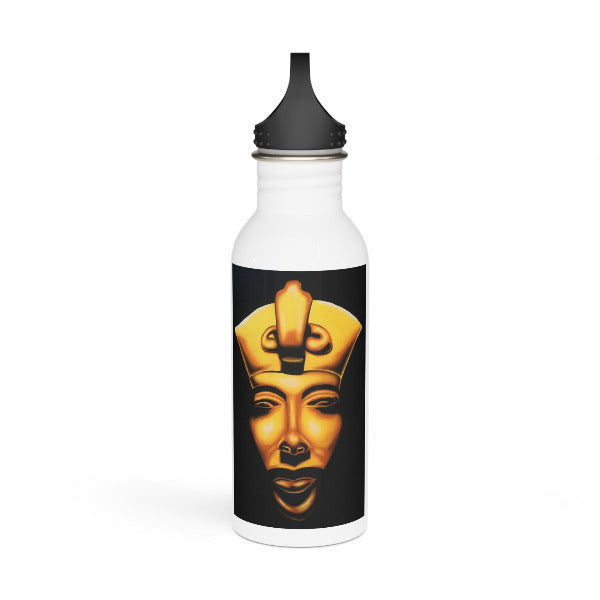
- Original artwork – unique painting capturing Akhenaten's distinctive features and regal power
- Revolutionary symbolism – representing vision, transformation, and challenging the status quo
- Premium 18/8 stainless steel – food-grade durability built to last
- 20oz capacity – keeps you hydrated while building your vision
- Wide neck design – easy drinking, easy cleaning
- Secure black cap – leak-proof reliability for revolutionary living
- Rich golden tones – vibrant colors capturing royal magnificence
- Smooth finish – sleek surface showcasing intricate artistic detail
The Revolutionary Who Changed Everything
Akhenaten didn't just rule—he revolutionized. In an empire where tradition was sacred and the priestly class controlled religion, politics, and culture, Akhenaten dismantled the entire system and built something radically new. He challenged the most powerful institution in the ancient world, relocated the capital, transformed artistic expression, and created a religious revolution that threatened everyone with power.
This water bottle exists because Akhenaten's story is essential for anyone building something new, challenging existing systems, or refusing to accept "that's how it's always been done." He proved that one visionary leader can transform an entire civilization—and paid the ultimate price for it.
What Made Akhenaten Revolutionary:
He challenged religious orthodoxy: Kemet had hundreds of gods and a powerful priestly class profiting from that complexity. Akhenaten said no—one god, the Aten (sun disk), direct relationship without priestly intermediaries. That was religious revolution.
He relocated the capital: He didn't just talk about change—he built an entirely new city, Akhetaten (modern Amarna), dedicated to his vision. That's commitment to transformation.
He transformed art: Traditional Egyptian art was formal, rigid, idealized. Akhenaten introduced realistic, intimate, emotionally expressive art—showing himself with his family, being affectionate, looking human rather than distant god-king.
He elevated his queen: Nefertiti wasn't just a wife—she was co-ruler, depicted at pharaoh size, wielding real power. That challenged patriarchal structures.
He was erased for it: After his death, his name was chiseled from monuments, his capital abandoned, his reforms reversed. The establishment tried to erase him. They failed—we're still talking about him 3,300 years later.
Why Akhenaten Matters Today
He proves one person can change systems: Everyone said it couldn't be done. The priests were too powerful. Tradition was too strong. He did it anyway. That's inspiration for anyone challenging entrenched systems.
He shows the cost of revolution: Akhenaten's reforms were reversed, his legacy attacked, his name erased. Revolution isn't comfortable. Transformation isn't popular. But it's necessary.
He demonstrates African genius: This wasn't Greek philosophy or Roman innovation—this was African intellectual revolution 1,000 years before classical Greece. That matters for understanding where revolutionary thinking originates.
He modeled visionary leadership: He didn't compromise his vision. He didn't water it down for acceptability. He committed fully, built the infrastructure for his vision, and changed history.
Who This Bottle Is For:
- The system-challenger: You're not accepting "that's how it's always been"—you're building something radically different
- The visionary leader: You have a clear vision that others don't understand yet, and you're committed to manifesting it anyway
- The revolutionary thinker: You question orthodoxy, challenge conventional wisdom, think independently even when unpopular
- The African history student: You're learning that revolutionary thinking, monotheism, artistic innovation—all came from Africa first
- The entrepreneur disrupting industries: Like Akhenaten disrupted religious systems, you're challenging business-as-usual
- The artist creating original work: Akhenaten transformed artistic expression—you're creating new forms, not copying old ones
The Artwork: Capturing Royal Power
This original painting captures Akhenaten's distinctive features—the elongated face, the powerful gaze, the regal crown. These aren't generic pharaoh features—they're specific to Akhenaten's revolutionary artistic style.
The golden tones: Rich, warm golds evoke royal power, divine connection, the sun (Aten) that Akhenaten worshipped. This isn't accidental color choice—it's symbolic.
The direct gaze: Akhenaten looks forward, focused, determined. This captures his revolutionary certainty—he knew where he was going even when others thought he was wrong.
The artistic style: This painting honors the Amarna artistic revolution that Akhenaten initiated—more realistic, more expressive, more human than the rigid formalism that preceded it.
The Religious Revolution
Monotheism before monotheism was cool: Akhenaten's worship of one god (the Aten) predates Judaism, Christianity, Islam. This was radical innovation in religious thought—and it came from Africa.
Challenging institutional power: The priestly class in Kemet was enormously wealthy and politically powerful. They controlled access to the gods, collected offerings, wielded influence. Akhenaten's monotheism eliminated their role. That's why they destroyed him after his death.
Direct spiritual connection: Akhenaten taught that people could connect directly with the divine (Aten) without priestly intermediaries. That's revolutionary—and threatening to religious hierarchies even today.
The Cost of Being First
He was vilified: Later pharaohs called him "the criminal" and "the heretic." His name was literally erased from king lists. That's what happens to revolutionaries in their own time.
His city was abandoned: Akhetaten, the capital he built, was deserted shortly after his death. His entire vision—architecture, religion, art—was systematically dismantled.
His legacy was attacked: For thousands of years, Akhenaten was remembered (when remembered at all) as a failed heretic, a misguided radical. Only modern archaeology revealed the sophistication of his vision.
But he endured: Despite systematic erasure, we know his name. We study his revolution. We recognize his genius. That's the paradox—they tried to erase him, and he became immortal.
Lessons from the Revolutionary Pharaoh
Vision requires commitment: Akhenaten didn't just talk about reform—he built an entire city for his vision. That level of commitment is what transforms ideas into reality.
Revolution makes enemies: When you challenge power structures, those benefiting from the status quo will fight you. Expect resistance. Plan for it. Persist anyway.
Build infrastructure for your vision: Akhenaten didn't just change ideas—he created physical structures (new capital, new temples, new art) that supported his vision. Infrastructure matters.
Being first is lonely: Akhenaten's vision was too radical for his time. It was reversed after his death. But the ideas didn't die—monotheism became dominant worldwide. Sometimes being first means you won't see the full fruits. Plant anyway.
For Kemetic Practitioners
If you're studying ancient Kemetic spirituality, Akhenaten represents a complex figure—revolutionary yet controversial, visionary yet divisive. He challenges simple narratives about ancient African spirituality.
He proves intellectual diversity: Ancient Kemet wasn't monolithic. It produced radical thinkers, revolutionary leaders, transformative visions. Akhenaten embodies that diversity.
He demonstrates spiritual evolution: Akhenaten didn't just preserve tradition—he evolved it, challenged it, transformed it. That's part of African spiritual history too.
Product Specifications
Material: Premium 18/8 food-grade stainless steel
Capacity: 20oz (0.59 liters)
Design: Full front decoration featuring original Akhenaten artwork
Cap: Secure black screw-on lid
Neck: Wide opening for easy drinking and cleaning
Finish: Smooth, sleek surface
Print Quality: Vibrant golden tones, fade-resistant, sharp detail
Durability: Built for daily use, lasting years
Note: Hand wash recommended for longest life; dishwasher safe
Care Instructions
• Hand wash with warm soapy water for best results
• Dishwasher safe (top rack recommended)
• Avoid abrasive cleaners that could scratch artwork
• Dry thoroughly before storing to prevent moisture buildup
• Not suitable for hot liquids (room temperature or cold beverages only)
Why This Revolutionary Inspires: You're building something new. Something different. Something that challenges how things have always been done. And people are telling you it won't work, it's too radical, you should be more reasonable. Akhenaten faced all of that 3,300 years ago. The most powerful priestly class in the ancient world told him no. Tradition told him no. Conventional wisdom told him no. He built a new capital anyway. He transformed religion anyway. He revolutionized art anyway. He changed an empire anyway. Yes, they reversed his reforms after his death. Yes, they tried to erase him. But we're still studying him. We're still inspired by him. We're still learning from him. That's the legacy of revolutionary vision—it endures even when systematically attacked. This bottle isn't just art. It's a daily reminder: one visionary can change everything. Systems can be transformed. Empires can be revolutionized. And when they try to erase you for it? Your vision endures anyway.

Get Free Educational Content
New videos, lesson plans, and African history insights delivered to your inbox
FAQs
Is the print framed?
The print is unframed so you can choose a frame that matches your space.
How long does shipping take?
Our products are made to order and custom printed just for you! Production takes 10–14 days, and once ready, they ship from the USA with tracking provided.
What if I don’t love it?
You’re covered by our 30-Day Money-Back Guarantee. Return it for a full refund—no questions asked.