


Printify
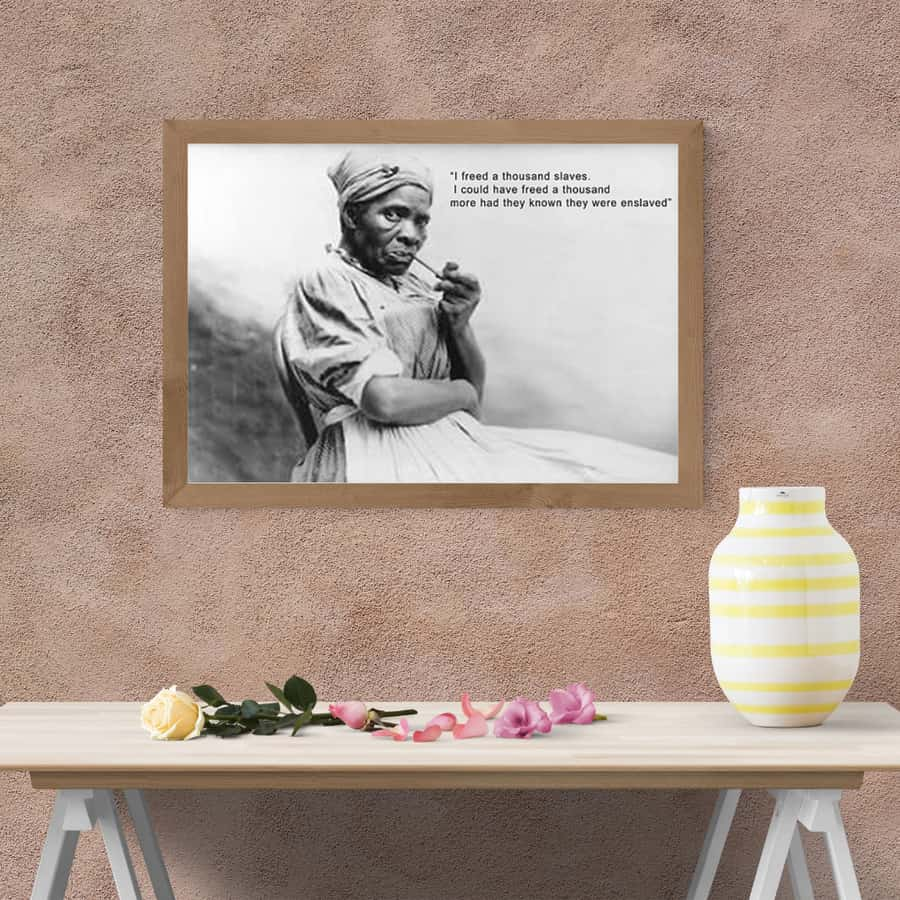
Harriet Tubman — Freedom & Resolve (Fine-Art Matte Print)
Harriet Tubman — Freedom & Resolve (Fine-Art Matte Print)
Couldn't load pickup availability
- Minimalist, museum-style design – powerful portrait paired with an awareness quote
- Black-and-white treatment – evokes the photography of Tubman's era
- 180 gsm fine art matte paper – archival look with no glare
- Horizontal format – multiple sizes; see the size options above
- Framing – artwork ships unframed; framed images are shown for display inspiration
👆 Choose your size above, then tap the button to add it to your cart
A striking black-and-white portrait of Harriet Tubman—a visual reminder of courage, vigilance, and the unbreakable will to be free.
The Design
This minimalist, museum-style composition pairs Tubman's powerful portrait with an awareness quote on the right side, creating a statement piece that commands attention. The black-and-white treatment emphasizes the timeless nature of her heroism and the stark reality of the choices she faced: freedom or death.
The clean, modern design makes this print versatile enough for any space while maintaining the gravitas her legacy deserves. It stands out in living rooms, offices, classrooms, and galleries—anywhere that honors courage and resistance.
Harriet Tubman: The Moses of Her People
Born into slavery (c. 1822) as Araminta Ross in Maryland, Harriet Tubman would become one of the most important figures in American history—an armed liberator, Union spy, nurse, and suffragist who risked everything to free others.
The Legendary Conductor
About 13 Trips. Roughly 70 People Freed. Never Lost a Passenger.
After escaping slavery herself in 1849, Tubman made approximately 13 trips back into slave territory over a decade (her early biographer Sarah Bradford put the number at 19), personally guiding about 70 enslaved people to freedom via the Underground Railroad. She carried a pistol not for offense, but to ensure that no one turned back and endangered the others—a testament to her strategic thinking and absolute commitment.
Her methods were brilliant:
- Traveled in winter when nights were longest
- Started journeys on Saturday nights, knowing runaway ads wouldn't appear until Monday
- Used songs and signals to communicate safely
- Carried a pistol for protection and to prevent panicked retreats
- Changed routes constantly to avoid detection
- Trusted no one completely except verified allies
Civil War Hero
During the Civil War, Tubman served the Union Army as:
- Scout and spy – Gathered intelligence behind Confederate lines
- Military leader – Guided and helped plan the Combahee River Raid (June 2, 1863) alongside Col. James Montgomery—widely recognized as the first armed raid of the war led by a woman—which freed more than 700 enslaved people in a single night
- Nurse – Treated wounded soldiers and refugees, often using herbal remedies from her knowledge of plants
Despite this service, she struggled for decades to receive proper military pension and recognition—a painful reminder of how Black women's contributions are chronically undervalued.
The Price She Paid
Tubman suffered a traumatic head injury as a teenager when an overseer threw a two-pound weight at another enslaved person and hit her instead. This caused:
- Lifelong seizures and headaches
- Sudden sleeping spells – episodes some historians link to epilepsy or narcolepsy
- Vivid dreams and visions which she interpreted as divine guidance
Rather than limiting her, Tubman used even these symptoms strategically—her visions often helped her sense danger and choose safe routes. She viewed her suffering as part of her calling.
Her Most Powerful Words
"I had reasoned this out in my mind; there was one of two things I had a right to, liberty or death; if I could not have one, I would have the other."
This was Tubman's core conviction: better to die free than live enslaved.
"I freed a thousand slaves. I could have freed a thousand more if only they knew they were slaves."
This line is widely attributed to Tubman, but there is no historical record of her saying it, and historians consider it apocryphal. It endures because it captures a truth her life embodied: mental liberation must precede physical freedom.
Why This Portrait Matters Today
Harriet Tubman's legacy speaks directly to our moment:
- Courage over comfort – She had escaped to freedom but returned about 13 times to dangerous territory
- Strategic thinking – Every move calculated, every risk assessed
- Community over self – Risked her life repeatedly for others' freedom
- Armed self-defense – Understood that liberation sometimes requires force
- Women's leadership – Led when society said women couldn't lead, especially Black women
- Persistence despite obstacles – Physical disability, poverty, racism—none stopped her
- Mental liberation – Helped people see they deserved freedom
About the Quote
Context note: The awareness quote paired with this portrait is a popular statement often seen alongside Tubman's image; historians have not verified its original authorship. Regardless of attribution, it captures the essence of vigilance and awareness that defined Tubman's life and continues to resonate with those who fight for justice today.
Perfect For
- Classrooms and libraries – Teaching resistance and American history
- Home offices – Daily inspiration for courage and persistence
- Living rooms – Centering Black heroism in family spaces
- Community centers – Honoring women's leadership and activism
- Girls' and women's spaces – Role model for strength and courage
- Social justice organizations – Symbol of liberation work
- Museums and galleries – Historical and cultural education
Teaching & Conversation Starters
This artwork opens discussions about:
- The Underground Railroad and resistance networks
- Women's roles in the Civil War and abolition
- Mental vs. physical liberation
- Armed self-defense in liberation movements
- Black women's leadership and erasure from history
- The ongoing fight for freedom and human rights
- Disability and heroism (Tubman's seizures didn't stop her)
- The cost of freedom and who bears it
Product Features
- Material: 180 gsm fine art photo paper
- Finish: Premium matte for archival look with no glare
- Sizes: Multiple sizes available—see the size options above
- Orientation: Horizontal
- Durability: Scratch and water resistant
- Quality: Crisp detail with vivid black-and-white contrast
- Use: For indoor display only
Care Instructions
If the print gathers dust, gently wipe with a clean, dry cloth. Keep away from direct sunlight and high humidity to preserve the paper's quality and prevent fading.
(Frame Not Included)
About the Artist's Vision
The black-and-white treatment isn't just aesthetic—it's historical. It evokes the photography of Tubman's era while emphasizing the stark moral clarity of her choices: freedom or death, action or complicity, courage or comfort. The minimalist design lets Tubman's face dominate—that direct gaze, that quiet strength, that absolute determination. No distractions. No softening. Just the unvarnished truth of a woman who changed America by refusing to accept bondage for herself or anyone else.
Her Lasting Legacy
Harriet Tubman died on March 10, 1913, in Auburn, New York, surrounded by family and friends. She was approximately 91 years old and had lived to see slavery abolished, though not to see full equality realized. Her last words were reportedly: "I go to prepare a place for you."
In 2016, the U.S. Treasury announced plans to place Harriet Tubman on the $20 bill—a symbol of her enduring place in American consciousness. More importantly, her example continues to inspire freedom fighters worldwide. From the Underground Railroad to modern abolition movements, Tubman's spirit lives on in everyone who risks safety for liberation.


Get Free Educational Content
New videos, lesson plans, and African history insights delivered to your inbox
FAQs
Is the print framed?
The print is unframed so you can choose a frame that matches your space.
How long does shipping take?
Our products are made to order and custom printed just for you! Production takes 10–14 days, and once ready, they ship from the USA with tracking provided.
What if I don’t love it?
You’re covered by our 30-Day Money-Back Guarantee. Return it for a full refund—no questions asked.